

From today - 2 November 2026 - Nationally Significant Infrastructure Projects will be required to deliver a minimum 10% biodiversity net gain , marking a significant shift in how major developments are planned, designed and delivered. Julia Baker, global submarket lead for biodiversity and nature at Mott MacDonald, tells Infrastructure Intelligence why this “once in a lifetime” legislation is a defining moment for both infrastructure and nature recovery.
Mandatory biodiversity net gain (BNG) requirements are about to become a reality for some of the UK’s biggest infrastructure projects.
Why is this so important? Because it embeds nature recovery into some of the country's largest infrastructure projects, ensuring biodiversity enhancement is considered alongside nationally significant investment in energy, transport and other critical infrastructure.
The significance lies not only in the size of the projects affected, but in the scale of habitat creation and enhancement they can deliver. By requiring a measurable 10% biodiversity uplift and securing those gains for at least 30 years, BNG has the potential to create, restore and better connect habitats across large areas of the country, making infrastructure delivery a contributor to nature recovery rather than a competing pressure on it.
The new requirement come into force today - 2 November 2026.
To mark the milestone, Mott MacDonald in partnership with ACE Group will host a special industry reception in London on 2 November, bringing together clients, consultants, contractors and professional bodies as the legislation comes into force.
For Julia Baker, global submarket lead for biodiversity and nature at Mott MacDonald, this is not just a shift in policy, but a “once-in-a-generation opportunity” to deliver nature restoration at scale.
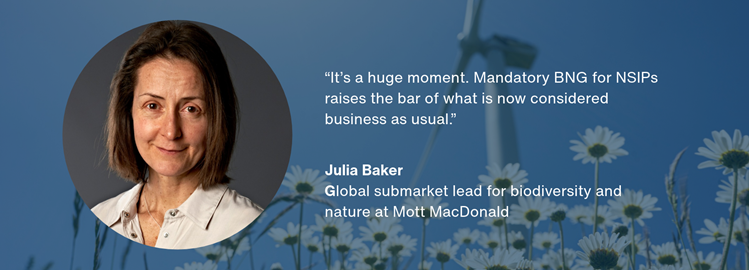
“It’s a huge moment,” she said. “To witness and be part of the introduction of legislation of this scale for nature and infrastructure development is truly extraordinary. Mandatory BNG for NSIPs raises the bar of what is now considered business as usual.”
For major infrastructure, meeting that standard will require more than calculating a score late in the design process. Project teams will need to plan for biodiversity early, coordinate it with engineering and construction and ensure habitats can be delivered and maintained over the long term.
BNG went live for major developments under the Town and Country Planning Act 1990 in February 2024 and was extended to small sites in April the same year.
Major developments typically include residential schemes of 10 or more homes, sites of 0.5 hectares or more where the number of homes is unknown, or non-residential developments on sites of at least one hectare.
Small sites cover developments below these thresholds, including minor housing schemes of up to nine homes.
Final BNG regulations and accompanying government guidance for NSIPs were published during spring and summer 2026, ahead of the mandatory requirement coming into force on 2 November 2026.
Where BNG is already in place, its impact is tangible. Earlier this year Defra said the first two years of its implementation had started to change the way development and nature work together with the policy set to safeguard between 6,000 and 10,000 hectares of habitat each year, roughly the size of Nottingham. It is also prompting developers to embed nature considerations much earlier in the design of projects.
BNG has now turned biodiversity improvement from a broad ambition into something that can be measured, enforced and maintained over the long term.
“There’s already a lot of good practice through the EIA process to mitigate the impacts of development” said Baker “Now we have a metric to quantify a 10% enhancement that is legally secured for at least 30 years. This mandatory requirement hasn’t been seen before, and it will become the norm.”
Excitement and responsibility
The scale of the opportunity brings both optimism and concern. The ambition could help infrastructure support nature’s recovery, but success depends on delivering functioning habitats – not simply meeting a metric on paper.
“Honestly, I feel equally nervous and excited,” said Baker. “The hard work now begins because the success of legalisation such as BNG is, to a large degree, about implementation. The infrastructure industry has a significant opportunity to get this right for both nature and infrastructure development.”
The requirement for at least 10% BNG set a clear baseline for projects. Baker says mandatory BNG creates a more consistent standard, but stresses that it should be viewed as a starting point rather than an end goal. “Ten per cent is a minimum,” she said.
Building on existing environmental protections and mitigation requirements, it raises expectations for how project account for nature.
Beyond the metric
The biodiversity metric will play a critical role in helping developers quantify and compare outcomes, but Baker warns against focusing solely on the numbers.
“There are always two sides of the biodiversity metric,” added Baker. “We need to get that balance between the metric being a guiding tool versus not only focusing on numbers in a spreadsheet, but rather designing habitat enhancement and creation based on sound ecological principles.
The location of BNG also matters.
“If, for example, we have a major linear project covering 200km how do we ensure that a project-wide 10% BNG is in the most optimal place for strategic and locally important nature restoration . The spatial presence of BNG is as equally important as the net gain itself.”
Nature as critical infrastructure
BNG also presents an opportunity to connect nature restoration with wider public value. Well-designed habitats and green infrastructure can support climate resilience, flood management, public wellbeing and access to nature, while helping communities adapt to a changing climate.
“Rather than see BNG as simply a compliance requirement, let’s consider nature as critical infrastructure for our communities, for society and for the economy” said Baker. “This is an opportunity to design, build and maintain the nature-rich, climate resilient infrastructure we truly need.”
Building the workforce
Delivering that vision will require collaboration across the industry and wider stakeholders, as well as a workforce equipped to integrate ecological thinking into project planning, procurement and delivery.
Baker believes major infrastructure projects could also play a key role in attracting new talent into the environmental sector.
“There are still too many social and economic barriers to becoming an ecologist,” added Baker. “But we have a real opportunity to bring in apprentices to these major projects and train the next generation of BNG ecologists on the job. The skills challenge is a risk, but it’s also something within industry’s gift to solve.”
A defining moment
The introduction of mandatory BNG for NSIPs represents one of the most significant changes to environmental policy affecting infrastructure in recent decades. While many organisations are familiar with implementing BNG under the Town and Country Planning Act, applying the principle at the scale required for nationally significant infrastructure will be a major undertaking.
Mott MacDonald’s special industry reception in London on 2 November to mark day one of the news legislation.
“People from across industry, government and the wildlife sector will come together because we share a mission for nature and believe BNG for NSIPs can play a part in delivering it,” said Baker.
“It’s important to recognise the significance of this moment and take a moment. Then the next day, the hard work begins for mandatory BNG for NSIPs to truly be successful”.
*BNG’s defining moment – nature gains the significance, is taking place on 2 November at Mott MacDonald, Great George Street, London from 18.30-20.30. Find out more here
News categories: Infrastructure Intelligence
- Share this page
-

-


