

Ancient and modern building materials have come together as HS2 progresses work on its Oxford Canal viaduct.
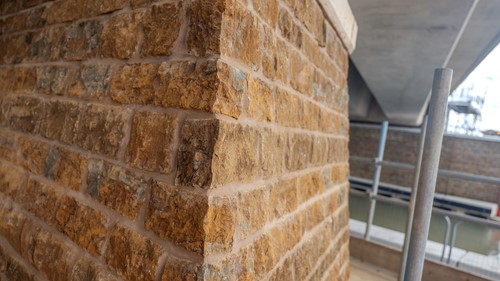
The site, near Wormleighton in Warwickshire, features locally sourced ironstone cladding. The hardwearing, warm-brown stone been a feature of local buildings for hundreds of years – including the nearby Church of St Peter in Wormleighton - and gets its name from the small quantities of iron ore contained within it.
It is now being used to clad key parts of the bridge which will carry high-speed trains over the historic waterway, as a nod to the canal’s architectural heritage.
Set low in the landscape, the viaduct’s three reinforced concrete spans will carry the new railway 62.5m across the canal, towpath and a country lane near the village of Wormleighton on the edge of Warwickshire and west Northamptonshire.
With the structure itself edging towards completion, focus has turned to the cladding that will surround the piers and abutment facing onto the towpath.
As part of the design process, local residents were given a choice of smooth concrete finish or a rough-cut masonry finish for the viaduct piers with the majority oping for ironstone, which was sourced locally.
HS2 senior project manager, Sam Arrowsmith, said: “More than 200 years ago, the first canals revolutionised transportation and helped to build the country we live in today so it’s fitting that our contemporary design includes a nod back to those 18th-century pioneers.”
The Oxford Canal viaduct is one of 15 viaducts and bridges being built by HS2’s main works contractor EKFB - a team made up of Eiffage, Kier, Ferrovial and Bam Nuttall - working with specialist architects Moxon and design partners ASC – a team made up of Arcadis, Setec and Cowi.
News categories: Infrastructure Intelligence
- Share this page
-

-


