

Hospital 2.0 - the government’s New Hospital Programme – has moved into its delivery phase following the signing of 11 contracts between the NHS and construction organisations. Among those is Willmott Dixon, which is to deliver the new Women and Children’s Hospital in Truro. Graham Dundas, Willmott Dixon's chief executive officer, considers what the building programme means for both the future of infrastructure, the way we build and local communities.
The government's New Hospital Programme is now moving into a new chapter.
Following an official reset plan and independent scrutiny by the National Audit Office (NAO), the unrealistic original target of building 40 hospitals by 2030 was been abandoned in favour of a realistic, multi-decade pipeline.
Eleven first-wave contracts are now moving forward, including plans at Royal Cornwall Hospitals NHS Trust (RCHT) – which has partnered with Willmott Dixon to deliver the new Women and Children’s Hospital in Truro.
Graham Dundas, chief executive officer of Willmott Dixon, says the project is significant for the Cornwall community but also for the way the country builds.
RCHT aims to bring acute maternity, neonatal, paediatric and gynaecology services together under one roof in a new facility. Cornwall is a rural peninsula served by a single acute provider for around 500,000 people across Cornwall and the Isles of Scilly.
Dundas said: “Distance matters here in a way it doesn’t elsewhere. For a family in the far west of the county, a hospital designed properly around them is incredibly important.
“What strikes me about RCHT’s ambition is that it reaches beyond the clinical brief. They want this building to be a source of civic pride and to make a real contribution to Cornwall’s long-term economic and social prosperity.”
Applying lessons learned
Willmott Dixon’s Wales and West team is already on site at Derriford Hospital in Plymouth, delivering the £140m Emergency Care Building for University Hospitals Plymouth NHS Trust, the first Wave 1 scheme in the New Hospital Programme to begin main construction.
“What we are learning at Derriford is about working within the New Hospital Programme environment, about building safely and quietly inside a live and pressured clinical environment and about meeting the NHS Net Zero Building Standard, now travels the 60 miles west with us. So does the team and the supply chain.
“In a region like the far South-west, a major hospital scheme is a key moment when sustained, high-quality work becomes available to local firms. We set deliberate targets for local spend within 10, 20 and 40 miles of our sites, because it is how the investment stays close to the building it paid for.
“On comparable health projects that has meant millions of pounds spent with businesses within 40 miles, alongside apprenticeships, T-level placement and our Building Lives Academies, which give people facing barriers to employment a genuine route into the industry.
“Two significant NHS schemes in the same region, delivered by the same business, also give local suppliers something important: visibility. A Cornish firm can invest, hire and train against work it can see coming.”
Collaboration is key
The Hospital 2.0 Alliance (H2A) is a centralised commercial framework that unites individual NHS trusts, major construction firms and the Department of Health and Social Care (DHSC) into a single collaborative team. Instead of treating each new hospital as an isolated, standalone building project, the alliance serves to design and build hospitals collectively.
“Ten construction partners now sit inside a single structure alongside the New Hospital Programme, NHS trusts, designers and the wider supply chain, working to Hospital 2.0’s standardised designs and technical standards,” added Dundas. “The advantages compound. Because a substantial proportion of the design is common across schemes, effort is concentrated on what is genuinely specific to each site and each community.
“As the structure is built for it, an improvement found on one hospital is captured once and deployed across every scheme that follows. This is a visible long-term pipeline that can support further investment in modern methods of construction and offsite manufacturing. And because NHS Trusts remain firmly in the lead, national consistency is achieved without local leadership being diluted.
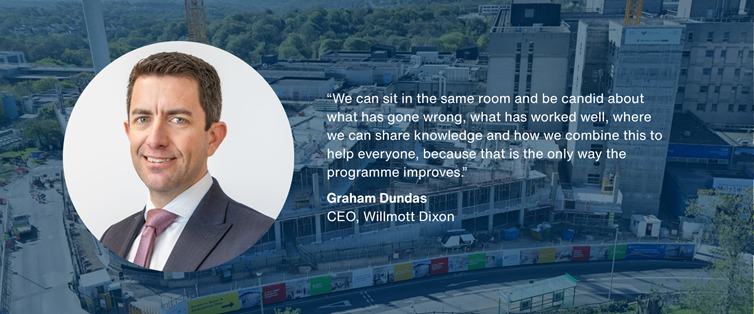
“This brings a big ask of us as contractors. Nine other Tier One businesses are in this alliance, so we can sit in the same room and be candid about what has gone wrong, what has worked well, where we can share knowledge and how we combine this to help everyone, because that is the only way the programme improves.”
A template beyond the NHS
“The implications of this collaboration reach well past the NHS estate. Structured alliancing has already proved itself in justice and defence. What is different here is the combination: programme-level collaboration, a standardised design platform and industrialised delivery, all at once.
“That is a model with obvious relevance to energy, education, water and transport, indeed any national programme where the country needs to build a great deal of the same thing, well, repeatedly, and cannot afford to relearn the same lessons every time.
“For an industry too often characterised by fragmentation and short horizons, that is a genuinely optimistic prospect.”
Willmott Dixon has delivered more than 100 healthcare projects across the NHS estate inthe past decade, most of them within live clinical settings where infection control, phasing and patient dignity are not negotiable. It is also a supplier on the £500m NHS Shared Business Services Decarbonisation of Estates Framework, which covers the South-west, and has delivered a major decarbonisation programme for Nottingham University Hospitals NHS Trust at the Queen's Medical Centre.
Dundas added: “RCHT with a long-standing ambition, a programme deliberately built for collaboration, and a team already delivering next door have all arrived at the same table at the same moment. Now let's build something that serves many thousands of people over many generations.”
News categories: Infrastructure Intelligence
- Share this page
-

-


