

Britain’s cities are getting hotter and trapping heat they can no longer release, according to new data from Ordnance Survey - putting infrastructure and communities under greater pressure
The findings follow a summer marked by record temperatures and repeated heatwaves, underlining the pressure rising heat is placing on urban areas.
Urban heat islands form when dense buildings, roads and other hard surfaces absorb solar heat during the day and release it slowly, keeping cities warmer than surrounding countryside. Rural areas tend to cool more quickly after sunset, while tall buildings and narrow streets can reduce wind speeds that would otherwise carry heat away. A lack of trees, vegetation and water also removes natural cooling from shade and evaporation, intensifying heat through the day and night.
To track these changes, OS produced the Heat Vulnerability Index by drawing on its detailed mapping of Britain’s built and natural environment, including building density and height, hard surface coverage, tree canopy, open vegetation and water across every city in England, Scotland and Wales.
It combined that data with satellite readings from 4 Earth Intelligence showing observed land surface temperatures against surrounding natural environments, and Met Office air temperature projections, to track how each city’s exposure to retained heat is expected to change through to the end of the century.
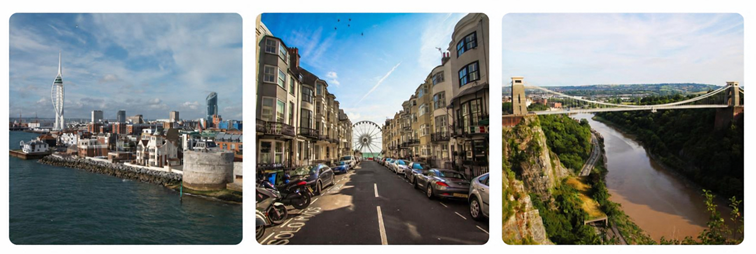
Not only is the urban heat island effect set to intensify in London, but cities like Portsmouth will be particularly vulnerable. Among those projected to warm most between present day and 2070 to 2100 are Leicester, Exeter, Nottingham, Brighton and Bristol.
OS analysis found that 83% of Britain's cities (59 cities) are already highly vulnerable to urban heat, with the remaining 17% (12 cities) classed as moderately vulnerable today. By 2040, rising summer temperatures are projected to push every city into the high vulnerability category, and by the turn of the century 45 cities are set to cross into severe heat vulnerability, the most serious level in the index.
Within the 10 most vulnerable cities today, Leicester is projected to see the biggest rise in Britain's heat vulnerability rankings, climbing from 10th today to fourth by the end of the century. Exeter and Nottingham also rise the rankings to enter the top 10 most heat vulnerable cities, alongside Bristol and Brighton and Hove, as rising temperatures reshape the geography of urban heat vulnerability across Britain.
Nick Bolton, chief executive officer (CEO) at Ordnance Survey, said: “These findings matter because cities are where millions of people live, work and spend their everyday lives. Extreme and sustained heat can affect people’s health and wellbeing, how comfortable our homes and workplaces are, and put additional pressure on transport, energy and emergency services.
“The OS Heat Vulnerability Index shows that by 2040, every city in Great Britain is projected to reach high vulnerability, and by the turn of the century, almost two-thirds could reach the most severe level. Understanding how and where this vulnerability is changing depends on an accurate view of how the country is built, based on trusted authoritative data, which is critical for planners, developers and local authorities preparing for a warmer future.
“What the Index shows is that the severity of urban heat islands is not uniform, and the cities most at risk of overheating during a heatwave are places where the built environment has grown at the expense of the natural one. Location-based insights like this have a critical role to play in evidence-based decision-making. They show where exposure is greatest as temperatures continue to rise, which of a city's existing green and blue spaces need protecting, and where different interventions could have the highest impact in protecting communities and strengthening national resilience.”
David Symons, Future Ready global lead at WSP, said adapting out towns and cities now is vital for the long-term climate resilience.
“These findings are another reminder that climate resilience is about much more than flooding. As the UK experiences hotter summers, many of our cities are becoming increasingly vulnerable to the urban heat island effect, where buildings, roads and hard surfaces absorb and retain heat long after temperatures have peaked.
“The challenge is not simply managing individual heatwaves but adapting our towns and cities to a future where periods of extreme heat become more common. That means thinking differently about how we design neighbourhoods, transport networks and public spaces, while protecting and expanding the green and blue infrastructure that helps cool urban environments naturally.
“Cities that invest in trees, green spaces, water features and climate-resilient design today will be better placed to protect public health, maintain productivity and reduce pressure on infrastructure and public services in the decades ahead."
Currently, the top ten most vulnerable cities are:
• Portsmouth
• Carlisle
• City of Westminster
• Newcastle upon Tyne
• Plymouth
• Aberdeen
• Perth
• Dundee
• Glasgow
• Leicester
OS warns the consequences extend “far beyond” uncomfortable summer days. Urban heat can increase risks to health, particularly for older and vulnerable people, while putting additional pressure on homes, workplaces, transport, energy infrastructure and public services.
The report comes after the UK experienced five heatwaves this summer, leaving nearly three-quarters of England in official drought status during the hottest summer on record.
To read more of the report, click here
News categories: Infrastructure Intelligence
- Share this page
-

-


