

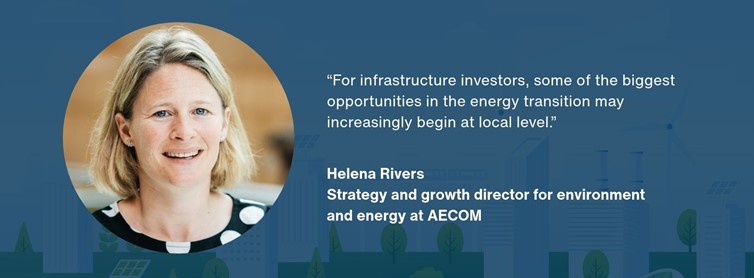
Strategic energy partnerships (SEPs) could provide investors with a new route into the UK’s growing pipeline of local energy infrastructure. Helena Rivers, strategy and growth director for environment and energy at AECOM, speaks to Infrastructure Intelligence about the opportunities they could unlock.
The government has put locally led energy firmly at the heart of its net zero agenda. Prime minister Andy Burnham has announced nearly £30m for locally owned clean energy projects across the UK, the first step in a £1bn programme intended to support more than 1,000 projects.
The direction is clear, with more of the energy transition going to be shaped and delivered locally. But ambition is one thing, turning it into infrastructure is another. Councils may know what their places need, but delivering projects across heat, power, buildings and transport requires not just significant investment but specialist expertise that the public sector cannot always provide alone.
That is where Strategic Energy Partnerships (SEPs) come in.
At its simplest, a SEP is a long-term public-private partnership designed to help a place turn its energy plans into deliverable infrastructure. A local or combined authority brings together private-sector partners that can provide investment, energy expertise and delivery capability, creating a framework through which projects can be developed and delivered over many years.
Rather than procuring a heat network, building retrofit programme or EV charging scheme separately, a SEP can bring them together as part of one coordinated programme. The precise mix differs from place to place because the partnership is built around the authority's own priorities and energy needs.
And the potential scale is significant. The smallest partnerships currently being developed are valued at around £1 billion, while the largest have been advertised at as much as £23 billion in combined construction value. Yet despite their scale, SEPs remain relatively unfamiliar to many infrastructure investors.
From individual projects to long-term partnerships
Brighton & Hove shows how the model could work in practice. The council has already identified a pipeline of priority projects spanning heat, power, buildings and transport, estimating that nearly £2.6bn of capital investment will be needed to decarbonise the city's energy system. It is now exploring a SEP as a long-term vehicle to unlock investment, accelerate delivery, generate community benefit and share risk between the public and private sectors.
This flexibility is important. While SEPs are typically associated with combined authorities, the model can operate at borough or city level too. What matters is that the partnership is designed around the opportunities of the place.
The public and private sectors also bring different things to the table. Local authorities can provide land, convene stakeholders, act as an anchor customer for heat and help identify and quantify the pipeline of projects. Private partners can bring capital, technical expertise and the capability to develop and deliver those projects.
Connecting the energy system
There is another reason this approach matters. The energy transition cannot be delivered as a collection of isolated technologies.
Heat, power, storage, transport and the electrification of buildings increasingly interact. A heat network has implications for the electricity grid, expanding EV charging creates new power demand, renewable generation can create opportunities for storage and flexibility.
A SEP provides a framework for looking at those needs together. Bringing electrical systems, storage, transport and heat expertise under fewer interfaces can make it easier to move from identifying individual opportunities to delivering an integrated local energy system – which in turn can lower the cost to the consumer.
Local projects, national opportunity
That is what makes SEPs relevant beyond the places developing them.
For local authorities, they offer a potential way to bridge the gap between setting ambitious energy plans and having the capital and capability to deliver them. For investors, they create access to long-term pipelines of projects of scale that might otherwise appear too small and fragmented.
Brighton & Hove illustrates the scale of that challenge particularly clearly. Its own roadmap identifies the projects needed, but the council explicitly says the scale of city-wide change goes beyond what the public sector alone can provide.
As more places face the same challenge, the government’s push towards locally led energy could reshape how a significant part of the UK’s next generation of energy infrastructure comes forward. Rather than being defined solely by a handful of nationally significant projects, it could be built through hundreds of locally identified schemes, brought together into investable programmes and delivered through long-term public-private partnerships.
For infrastructure investors, that means some of the biggest opportunities in the energy transition may increasingly begin at the local level.
News categories: Infrastructure Intelligence
- Share this page
-

-


