

Britain’s economic ambitions increasingly hinge on the ability to build.
From the goal of 1.5 million new homes to transport and energy infrastructure, construction has become the government’s go‑to lever for boosting productivity, creating jobs and unblocking growth.
For Andy Temple, WSP’s executive managing director for property and buildings across the UK and Ireland, it makes for a sector rich with opportunity - but also with challenges to tackle.
“We need a stable and reliable project pipeline to unlock investment – and confidence,” he said. “Developers will commit when they know timetables are dependable or they can predict with the right degree of certainty. But we need more delivery and less strategy to get things moving in the right direction.”
Temple has recently taken the reigns of WSP’s property and buildings division. Promoted from senior operations director, he has been passed the baton from Kamran Moazami – the man behind iconic high-rise developments such as The Shard, 22 Bishopsgate and One Blackfriars – who has moved into a new role within WSP as executive design principal.
“It’s a real privilege to take over from Kamran,” said Temple, “he’s a force of nature, a great mentor and someone who has really driven our business forward over recent years.”
WSP’s property and buildings business now employs nearly 1,600 staff across the UK, including colleagues from the company’s Global Capability Centre across Bangalore and Noida supporting the UK market (around 1,350 in the UK and a further c.300 in the GCC).
“There were tough market conditions last year,” he said, “but we are seeing some big infrastructure projects moving forward now and increased confidence. People are looking at the UK as a positive place to invest – we just need to increase that confidence around viability and deliverability.”
WSP is currently working on many transformational building projects that are creating new communities and a renewed sense of place.
The Alma Estate regeneration in Enfield and the Elephant and Castle Town Centre redevelopment are transforming London neighbourhoods. It is also involved with the Earls Court masterplan – a low carbon regeneration of one of London’s largest cleared development sites. WSP is also working on One Undershaft, which will become the tallest building in the City of London.
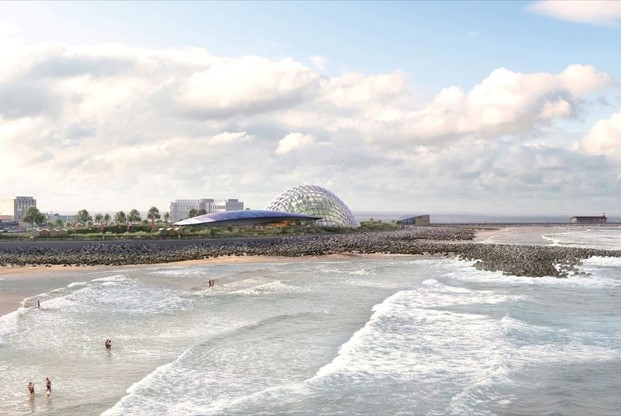
New construction projects are delivering knock‑on gains for both the economy and the places around it. WSP is involved with the £100m Eden Project North being planned for Morecambe, along with hospital schemes and airport programmes at Heathrow and Gatwick.
Temple says urban regeneration, defence and the Government Property Agency’s work leading the largest commercial office programme to deliver a smaller, better and greener estate are just some of the areas driving growth in the sector.
While there is much work to be done, and a desire from government to put growth at the top of the agenda, progress is now needed. But the sector still faces big challenges.
“We need projects to come through planning in a more predictable and reliable way,” said Temple. “We’re still facing a lot of pressure around inflation which is affecting the viability of projects and the sector as a whole faces a talent shortage.
“We need to nurture more young professionals and bring more talent into the industry. When you look at some of the big schemes that are starting to progress – the new hospitals programme and big defence schemes for example – there will be a skills gap which has the potential to affect the deliverability of some schemes. Plus, a skills gap will push some prices up further, and that starts to impact viability.”
The National Infrastructure and Service Transformation Authority (NISTA) recently published details of its expanded pipeline, detailing 734 planned projects covering £718bn of private and public sector investment over the next decade.
It says delivering projects in the pipeline will require an estimated annual average construction and infrastructure workforce of between 629,000 and 706,000 over the next five years.
Temple said having more projects in the pipeline was good news for industry.
“You need a much bigger pipeline because of uncertainty in the market – having a larger, more diverse pipeline creates more opportunity. It’s also important for people working in the industry, it creates opportunity for people to work on different projects and at different stages of development.”
Housing remains a core focus of the government’s growth ambitions, with housing secretary Steve Reed’s call to arms of “build, baby, build” driving the pledge to develop 1.5 million new homes in England over the course of the current parliament by 2029 to tackle the housing crisis. It means 300,000-370,000 homes being delivered annually through planning reform, focusing on brownfield development, utilising “grey belt” land, and increasing social rent housing.
“It is an ambitious target,” said Temple, “but if we don’t set ambitious targets then we won’t achieve anything like it.
“But we need planning reform, we need to streamline the process and have consistent policy and investment in the infrastructure that will enable those homes.”
In March the government announced the seven locations proposed as new towns, with each location delivering at least 10,000 homes with several delivering up to 40,000.
“It’s not just about homes,” added Temple, “you need schools, stations, roadways, railways – all the infrastructure that’s required to deliver that – and that all needs investment.
“But that’s why we need the ambitious target, so we drive as hard as we can to achieve it.”
There has been significant and widespread criticism of the Gateway 2 process, a key component of the Building Safety Act 2022 designed to ensure higher-risk buildings (HRBs) are safe before construction begins. It has led to delays in project starts.
But Temple says it’s an “improving picture”. He added: “Delays through Gateway 2 do create some real issues. But I think really strong and well-designed projects are continuing to progress well.”
For Temple, working in the building sector carries a deeper purpose: the chance to shape the places where people live and work, and to leave them better than they were before.
“Our input leaves a lasting impact on a place, and if we have the opportunity to leave it a better place than we found it then that has real, meaningful impact,” he said.
When asked to name a favourite building or project, Temple admits it’s a tough ask.
He said The Shard stands out. As structural engineer, WSP was responsible for the design of The Shard and its team was on site throughout its construction. But Temple says its not the building's height of iconic design that makes the impact. “It’s important for the real change it created in that part of London,” he explained.

“When I started working, you’d come into London Bridge and everyone would just want to get across the river to the north side. You didn’t spend time there.
“The Shard and London Bridge station has created a real sense of place, a focal point for that side of the river. It’s led to more vibrancy across the whole area, real urban regeneration.”
Hospital projects also resonate with Temple, who in his career has worked on projects including those at Royal London Hospital and Great Ormond Street Hospital.
“You have your best and worst moments in hospitals,” he said. “When your children are born it’s the most joyous moment, but when you have an accident or a family member is unwell it’s where you go for support, comfort and treatment.
“So, if we can make a bit of a difference to people’s lives with the way we design these spaces, that’s really quite special.”
He added: “It’s wonderful to look at a skyline and see great building design and as engineers we thrive on complexity and see that as an opportunity to innovate and solve problems. But ultimately buildings are about people.
“They are where people live, work, where they go when they’re not well. So, it’s about creating great places where people want to be. That’s what’s important to me.”
News categories: Infrastructure Intelligence
- Share this page
-

-


