

Alex Herbert, WSP’s new major projects director in its infrastructure planning business, talks exclusively to II about why it's a defining period for infrastructure delivery across the UK
Large-scale infrastructure projects are set to reshape UK communities and the country’s economy in the years ahead.
This shift is particularly evident in the energy sector, where new nuclear plants, wind farms and power generation projects are progressing alongside a major transformation of the transmission network.
Plus, the ambition is to bring these projects online more rapidly – with new reforms now confirmed to speed up the approval process for Nationally Significant Infrastructure Projects (NSIPs) alongside the landmark Planning and Infrastructure Act. The UK government has also updated the National Policy Statements for energy infrastructure to align with the Clean Power 2030 mission.
Alex Herbert, WSP’s new major projects director in its infrastructure planning business, said: “It’s a hugely positive time for infrastructure development, yet the scale of consultations and changes to the system is unprecedented. I don’t say that in a negative way, much of this change has been long overdue such as the new national policy statements that we have waited so long for.
“It’s great that this is being put into place and should ultimately help with delivery of all forms of infrastructure, but particularly energy. But there have been delays in consenting of projects – that’s something that needs to be addressed.”
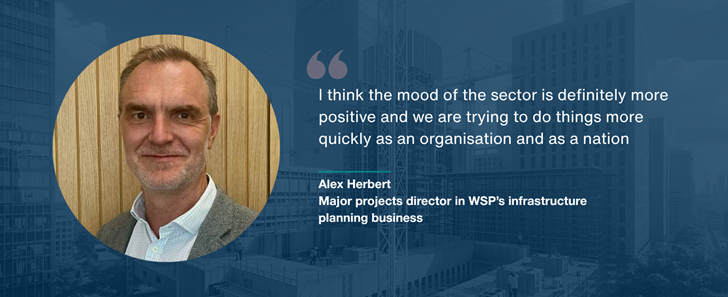
Herbert has joined WSP following more than 15 years in senior client-side development roles, working with organisations including RWE Renewables, Low Carbon, Horizon Nuclear Power and Tidal Lagoon Power.
He brings extensive experience leading the planning, promotion and consenting of complex energy schemes spanning offshore wind, nuclear, solar and tidal. Energy will continue to be his principal area of focus.
The impact of NSIPs
WSP is heavily involved in the UK’s NSIP regime, having worked on approximately 75 Development Consent Order (DCO) applications since 2008. Because it works across energy, transport and water, its active NSIP work includes prominent projects such as low carbon and hydrogen energy project HyNet North West and National Highways Strategic Road Network.
WSP is also working on transformative energy schemes. It was recently appointed, alongside Mott MacDonald, by Great British Energy - Nuclear (GBE-N) to provide specialist environmental services and permitting support for the Small Modular Reactor (SMR) programme at Wylfa, helping accelerate Britain’s transition to low-carbon energy.
By their nature, major infrastructure projects are complex, expensive and can take decades to come to fruition. Longer term planning is needed, said Herbert.
“We are already two years into the current Labour term,” he said, “given the lifecycle of an NSIP project and the Development Consent Order application, you already need to be having conversations about what’s likely to happen at the next general election.”
Collaboration is also key. “At WSP the planning and environment teams sit together and work closely and I think that’s absolutely critical for project delivery.”
Delivering transformative infrastructure is critical to long-term growth across the UK. Effective planning ensures decisions about development are right and deliver meaningful outcomes for the economy, environment and communities.
“The planning stages are so important. It’s not about rushing out to dig a hole to show progress. It’s important for consultancies to engage with projects early, integrating all the disciplines to make sure the right decisions are made from the outset and avoid the cliché of making big projects late and expensive.”
This can currently be seen in the nuclear sector with Sizewell C in Suffolk being built as a near replica of Hinkley Point C in Somerset - taking all of the lessons and innovation to build the second power station at a lower cost. But the UK has had to play catch-up.
South Korea, for example, is among the world's most prominent nuclear energy countries and exports its technology widely. According to the World Nuclear Association, it has 26 operable reactors and four under construction. Nuclear power supplies 30%-32% of the country's total electricity generation, producing around 189 TWh annually - from 26 GW of plant.
This compares to the UK where nuclear accounts for around 12% of the UK’s electricity generation. EDF manages five active, electricity-generating nuclear power station sites in the UK comprising a total of nine operational reactors. But there is ambition for growth - the government wants to scale up nuclear capacity to 24 GW by 2050, which would quadruple current output and supply roughly a quarter of the nation's electricity demand.
“In the time that we didn’t build nuclear power stations South Korea built many, and in doing so did that to a formula, sharing lessons learned across the development cycle of each project. They have developed faster and more cheaply than we’ve been able to.”
Challenges to overcome
Grid connections have been one of the biggest constraints on energy development in the UK, especially for renewables, storage and major demand projects. In simple terms, many projects have secured planning progress or investment interest but cannot move forward at pace because they are waiting for a connection to the electricity network.
“Grid connection reforms have slowed things down. The reforms are necessary, but it means some projects have struggled.”
Complex geopolitical factors also put major infrastructure schemes under strain. Creating a climate for development and investor confidence is key. The government’s 10-year Industrial Strategy has set out ambitions for growth in eight key areas - helping to boost investor and business confidence while providing a crucial catalyst for long-term planning.
“All projects have their outside influences that cause problems and the world does seem particularly volatile at the moment. But the government is doing all it can to show commitment and we have to hope that investors do the same. I think the mood of the sector is definitely more positive and we are trying to do things more quickly as an organisation and as a nation. If the will and the resourcing is there, we can still do things fast.”
Recent construction market data suggests the sector is beginning to improve, with activity edging upwards, albeit at a very slow pace.
Latest construction data from the Office for National Statistics showed output grew by 0.3% from April-June with both new work and repair and maintenance up by 0.4% and 0.2%, respectively. The most recent S&P Global UK Construction Purchasing Managers’ Index (PMI) – an index tracking changes in total industry activity - also showed an improving picture. At 44.7 in July, up from 38.4 in June, output reached its highest level for four months. While still below the neutral 50.0 threshold, output levels fell at the slowest pace since March.
The future?
The next 15 years have the potential to bring about dramatic change to the country’s major infrastructure.
“By 2050 we should have transformed our energy system,” said Herbert. “It should be unrecognisable in terms of generation and distribution. Water infrastructure should also be completely transformed– and all of that should have real tangible impacts on people’s lives.
“From how they fuel their cars and homes to how comfortably they live – even whether they must deal with hose pipe bans – all of that should be a thing of the past.
“We don’t yet know how far digital infrastructure will develop, but it should be very real and notable. So, it’s a very exciting time to be part of this.”
News categories: Infrastructure Intelligence
- Share this page
-

-


