

The construction of one of the most complicated parts of the HS2 project took a step forward over the Christmas break, with completion of two key viaduct spans over the existing railway near Water Orton in Warwickshire.
The spans form a small part of the Delta junction – a huge triangular intersection being built to the east of Birmingham for the new high-speed railway.
Like the nearby Spaghetti Junction, it is formed of a complex series of interconnected viaducts, taking the high-speed line over motorways, local roads, existing railways, rivers and floodplains. It is designed to carry HS2 services to and from Birmingham, as well as connecting to the mainline heading north and south.
To maintain speeds of 360km/h on the mainline and around 200km/h on the approaches to Birmingham, the junction is stretched out over a far larger area than a motorway junction, with 2.6 miles of track, including underpasses, flyovers and five major viaducts.
The Water Orton viaducts are at the northern end of the junction and will allow southbound trains to join the spur into Birmingham Curzon Street and the rolling stock depot at Washwood Heath.
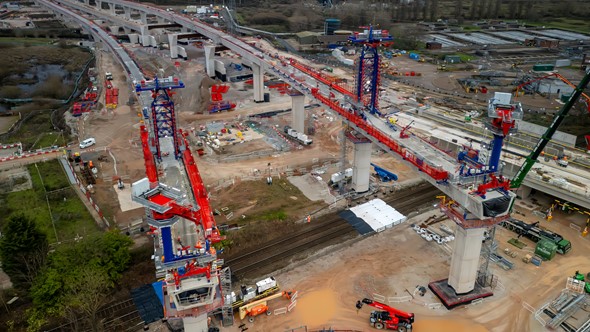
Engineers working for HS2’s local main works contractor Balfour Beatty VINCI used a five-day closure over the quieter Christmas period to safely complete the two parallel spans over the existing Birmingham to Peterborough railway line.
With the railway crossing complete, the team can move on to the next sections of the viaducts over the nearby A446 road and the M42 motorway.
The Water Orton viaducts form part of 3.7 miles worth of viaduct across Delta junction which are being built using this approach. All 2,742 concrete segments needed for the viaducts are being manufactured at a temporary factory at nearby Lea Marston.
HS2 is currently at peak production with all 23 miles of deep-bore tunnels now excavated on the opening section of the railway between Old Oak Common and Birmingham Curzon Street. Figures show 70% of the project’s vast earthworks programme has now been delivered and almost 300,000 tonnes of steel has been used – 69% of that required for the railway.
It is now focused on completing the complex civil engineering programme across the 140-mile route, ahead of the next vital stage when the track, signalling and communications systems that form the basis of the operational railway are installed.
A year since Mark Wild’s appointment as chief executive of HS2, the project is now at an advanced stage of a comprehensive reset.
He said: “I made a commitment to the transport secretary that I would address the failures of the past and get HS2 on track. It’s clear that we can only do so with a fundamental reset.
“Over the last year we’ve been through the programme with a fine tooth comb and we’re now very close to establishing a clear path forward.”
Wild has already provided advice to the transport secretary confirming that the railway’s 2029/2033 opening schedule cannot be achieved. HS2 has since been finalising a new range of credible cost and schedule estimates. These draw on the same methodology Wild used when he reset Crossrail – paving the way for the successful opening of the Elizabeth Line.
Wild added: “However, we’ve not stood still. We had to deliver a safe and productive year while HS2 was reset and I want to thank the 34,000 people working on the project every day for their tremendous hard work. The solid progress they’ve made in the last year gives us strong foundations to build upon. We’ve shown what can be done and I expect that to continue throughout 2026 and beyond as we deliver HS2 as safely and efficiently as possible and for the lowest reasonable cost.”
HS2 has around 350 active work sites between London and Birmingham and in 2025 HS2 has increased the number of staff in front-line construction roles to help drive productivity. Additionally, the company has made greater use of real-time information, with a traffic light system identifying where construction is on track - or fails to match expectations - to ensure progress is made across the route.
As part of the reset, significant changes have already been made. In 2025 HS2 has:
- Toughened up cost controls to ensure annual budgets are carefully managed – maximising the use of taxpayers’ money. New specialist commercial roles now scrutinise every contractor payment, with independent expert panels verifying all major decisions.
- Established a new construction schedule to prioritise completing the initial phase of the railway between Old Oak Common and Birmingham. This includes finishing an initial 50-mile stretch first between HS2’s new network integrated control centre in Washwood Heath, Birmingham, and the Wendover green tunnel in Buckinghamshire so testing can begin.
- Strengthened the leadership team. A new chair, Mike Brown, and six new non-executive directors have joined the board, while new executive appointments address critical skills gaps - Ruth Dunphy joined as chief transformation officer and Morag Stuart as chief commercial officer.
- Slimmed down the corporate centre – cutting 300 permanent corporate roles and redeploying or appointing over 150 to frontline civil delivery roles.
News categories: Infrastructure Intelligence
- Share this page
-

-


